

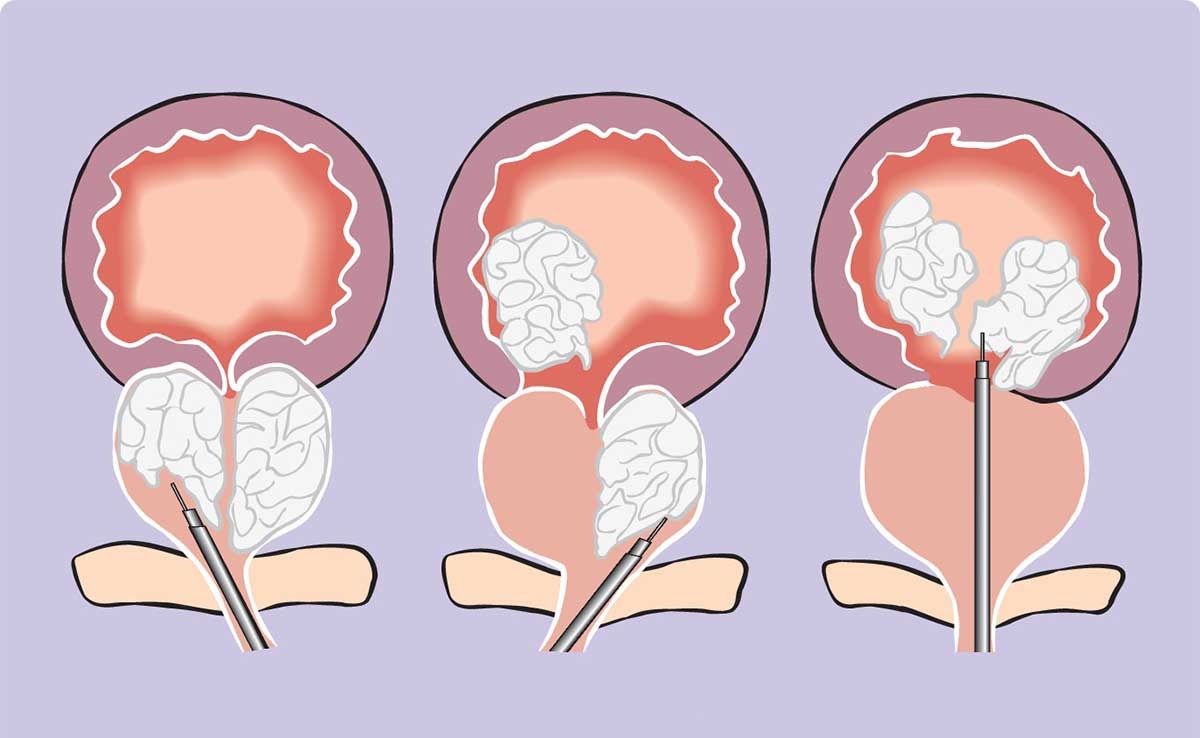
HoLEP (Holmium Laser Enucleation of the Prostate) is a closed, endoscopic surgery used to treat urinary obstruction caused by benign prostatic enlargement. During the procedure, the obstructing prostate tissue is separated from the surgical capsule using a holmium laser and removed.
HoLEP is performed without any external incision and can be applied across a wide range of prostate sizes. The decision to operate is based not only on gland size but on symptoms, urinary flow rate, post-void residual urine, bladder function, and general health.
Last medical review: 2026
Who may benefit from HoLEP?
HoLEP may be a surgical option for persistent, quality-of-life-affecting urinary symptoms despite medication; significantly weakened flow with incomplete bladder emptying; recurrent acute urinary retention or catheter dependence; recurrent infection related to prostatic obstruction; bladder stones or recurrent bleeding; kidney function affected by prostatic obstruction; or persistent or recurrent obstruction after a prior prostate procedure. Not every enlarged prostate needs surgery, and a smaller prostate can also cause significant obstruction — treatment is individualized. See our BPH guide for a broader overview.
Pre-operative evaluation
Evaluation before HoLEP typically includes assessment of symptoms and their impact on quality of life, PSA testing and prostate cancer risk assessment, urinalysis and culture when needed, ultrasound to assess prostate volume, the kidneys, and post-void residual urine, uroflowmetry, and, in select patients, cystoscopy or urodynamic testing. Blood thinner use and anesthesia risk are also reviewed. An elevated PSA should not automatically be attributed to benign enlargement — if findings are suspicious, further evaluation for prostate cancer may be needed before surgery.
How is the procedure performed?
HoLEP is performed under general or spinal anesthesia. Endoscopic instruments are introduced through the urethra without any external incision. The obstructing prostate tissue is separated from the surgical capsule using the holmium laser, moved into the bladder, and reduced in size with a morcellator device for removal. After bleeding is controlled, a temporary urinary catheter is placed. The removed tissue can be sent for pathological examination.
Potential advantages
Potential benefits include no external surgical incision, applicability across different prostate sizes, removal of a large proportion of obstructing tissue, laser-assisted bleeding control, generally shorter hospital stay and recovery than open surgery, a relatively low likelihood of needing repeat surgery, and the ability to examine the tissue pathologically. These benefits are not guaranteed for every patient and depend on prostate anatomy, bladder contractility, comorbidities, and surgical experience.
Can HoLEP be performed on blood thinners?
HoLEP's bleeding-control properties can make it a suitable option for some patients on blood thinners, but this is not the same for every patient. The type of medication, the reason it is prescribed, and bleeding/clotting risk must be evaluated together. Blood thinners should never be stopped by the patient on their own — the pre-operative medication plan is decided jointly by urology, anesthesia, and, when relevant, cardiology.
What are the risks?
As with any surgery, possible complications include temporary burning, urgency, or frequent urination; bleeding or clots in the urine; urinary tract infection; temporary inability to urinate after catheter removal; temporary incontinence; rarely, persistent urinary control problems; urethral or bladder-neck stricture; and, rarely, the need for an additional procedure or blood transfusion due to bleeding.
Does HoLEP cause incontinence?
Temporary leakage — particularly with coughing, standing, or movement — can occur early after surgery and generally improves during recovery in most patients. Prostate size, bladder function, age, and surgical technique can all influence recovery time. Pelvic floor exercises may be recommended when needed, and persistent or significant incontinence should prompt further urological evaluation.
Does HoLEP affect sexual function?
Erectile function is preserved in most patients after HoLEP, though this cannot be guaranteed for every individual and depends on baseline function, age, vascular disease, diabetes, and medications. Absent or reduced antegrade ejaculation is common after the procedure, and while orgasmic sensation may continue, natural fertility can be affected — a topic that should be discussed before surgery by patients who wish to have children.
HoLEP versus ThuFLEP and TURP
HoLEP and ThuFLEP are both laser enucleation techniques separated only by their energy source — holmium versus thulium fiber laser. TURP removes obstructing tissue by cutting it into small chips rather than enucleating it along the capsule. All three can be effective; the appropriate choice depends on prostate volume and anatomy, bleeding risk, and the surgeon's experience with the specific technique.
Does HoLEP treat prostate cancer?
No. HoLEP treats the urinary obstruction caused by benign prostatic enlargement; the entire gland and its capsule are not removed. Cancer can occasionally be found incidentally in the removed tissue, in which case further evaluation, follow-up, or treatment is planned based on its characteristics.
Frequently asked questions
Is HoLEP suitable for every patient?
HoLEP is an effective option, but suitability depends on bladder function, urethral stricture, suspicion of prostate cancer, prior surgery, blood thinner use, and anesthesia risk, all assessed individually.
Does HoLEP have a different outcome from TURP?
Both can be effective. HoLEP removes tissue along the surgical capsule rather than cutting it into chips, and the appropriate method depends on prostate volume, anatomy, bleeding risk, and surgical experience.
Does the prostate grow back after HoLEP?
Because a large proportion of obstructing tissue is removed, the likelihood of needing repeat surgery is generally low, but no technique can guarantee that regrowth or further treatment will never be needed.
Source: European Association of Urology (EAU) Guidelines on the Management of Non-neurogenic Male LUTS, 2026. This content is for general information only and does not replace individualized medical evaluation. Prepared and medically reviewed by Professor Cenk Acar, Urologist.