

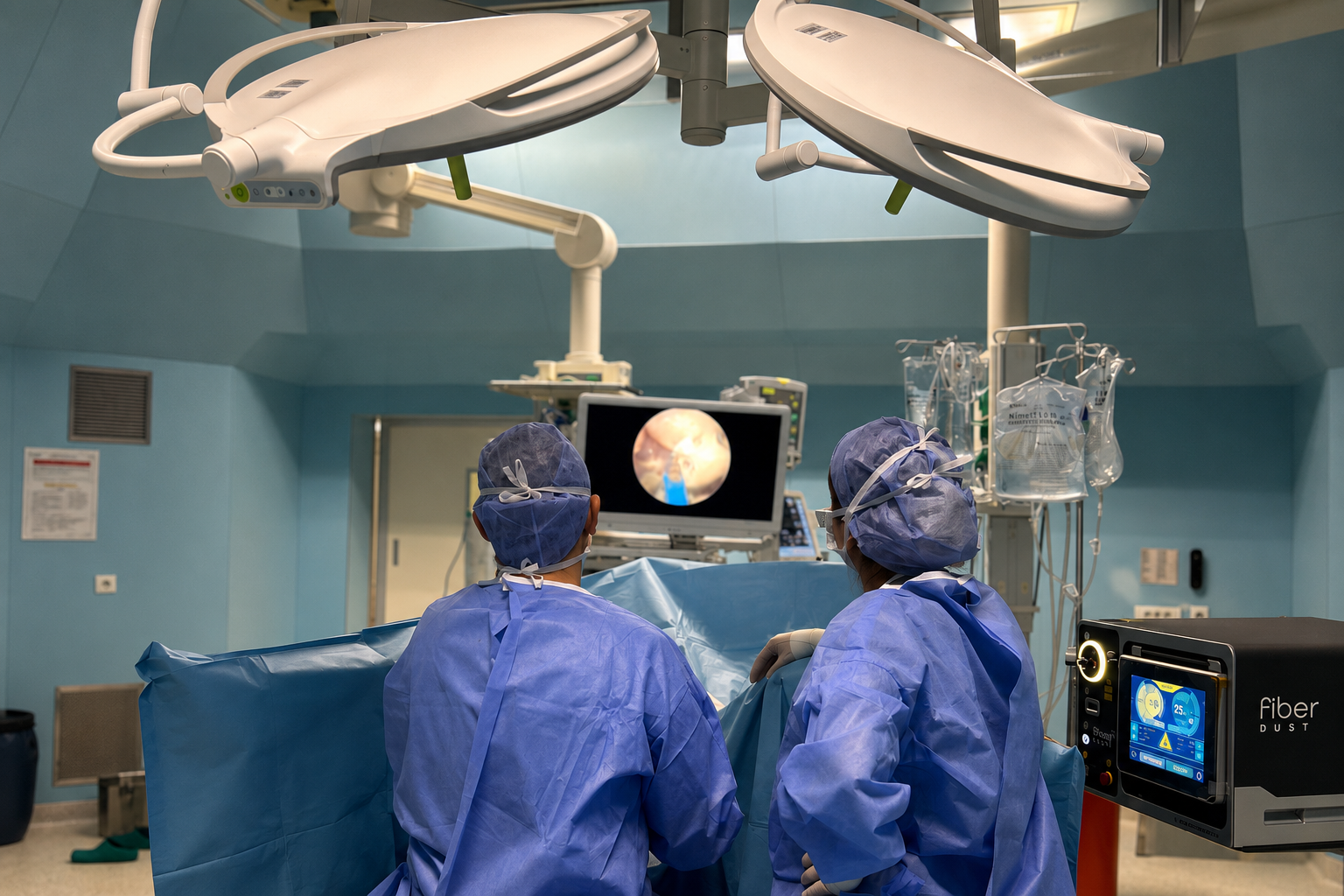
ThuFLEP (Thulium Fiber Laser Enucleation of the Prostate) is a closed, endoscopic surgery used to treat urinary obstruction caused by benign prostatic enlargement. During the procedure, the obstructing prostate tissue is separated along the natural surgical capsule and removed.
ThuFLEP is an anatomical enucleation technique that can be applied across a range of prostate sizes without any external incision. Suitability for surgery is assessed individually, based on symptoms, prostate volume, urinary flow rate, post-void residual urine, and general health.
Last medical review: 2026
Who may benefit from ThuFLEP?
ThuFLEP may be considered for persistent urinary symptoms despite medication, significantly weakened flow with incomplete bladder emptying, recurrent acute urinary retention or catheter dependence, recurrent infection related to prostatic obstruction, bladder stones or recurrent bleeding, or kidney function affected by prostatic obstruction. Not every enlarged prostate requires surgery — the decision is based on the degree of obstruction and its impact on quality of life, not gland size alone. For a broader overview of benign prostatic enlargement, see our BPH guide.
How is the procedure performed?
ThuFLEP is performed under general or spinal anesthesia. Surgical instruments are introduced through the urethra without any external incision. The obstructing prostate tissue is separated from the surgical capsule using the thulium fiber laser, then moved into the bladder and reduced in size with a morcellator device for removal from the body. After bleeding is controlled, a temporary urinary catheter is placed. The removed tissue can be sent for pathological examination.
Potential advantages
Potential benefits include no external surgical incision, applicability across a wide range of prostate sizes, removal of a large proportion of the obstructing tissue, laser-assisted bleeding control, generally shorter hospital stay and recovery compared with open surgery, a relatively low likelihood of needing repeat surgery over the long term, and the ability to examine the removed tissue pathologically. These benefits are not identical for every patient and depend on prostate anatomy and size, surgical technique, comorbidities, and surgeon experience.
Recovery after ThuFLEP
Hospital stay and catheter duration vary by individual. In most patients the catheter can be removed within a short period, with discharge planned once voiding is confirmed. In the first days, mild bleeding in the urine, frequent urination, urgency, or burning on urination may occur and usually improve as healing progresses. Avoiding heavy lifting and strenuous exercise, and maintaining adequate fluid intake, for the period advised by the surgeon is important.
What are the risks?
As with any surgery, possible complications include temporary burning, urgency, or frequent urination; bleeding or clots in the urine; urinary tract infection; temporary incontinence; rarely, persistent urinary control problems; urethral or bladder-neck stricture; temporary inability to urinate requiring a further period of catheterization; and, rarely, the need for an additional procedure or blood transfusion due to bleeding.
Does ThuFLEP affect sexual function?
Erectile function is preserved in most patients after ThuFLEP. However, absent or markedly reduced antegrade ejaculation is common after the procedure — known as retrograde ejaculation or anejaculation. Orgasmic sensation may continue, but natural fertility can be affected, which should be discussed with the treating physician before surgery by patients who may wish to have children.
ThuFLEP versus HoLEP
Both are laser enucleation techniques aimed at removing obstructing prostate tissue along the surgical capsule. The main difference is the laser energy source: ThuFLEP uses a thulium fiber laser, while HoLEP uses a holmium laser. The preferred technique depends on the patient's characteristics, prostate anatomy, available equipment, and the surgeon's experience with the specific technique.
Does ThuFLEP treat prostate cancer?
No. ThuFLEP primarily treats urinary obstruction caused by benign prostatic enlargement; it is not a prostate cancer operation. If PSA is elevated, examination findings are suspicious, or prostate MRI shows a suspicious lesion, separate evaluation for prostate cancer may be needed.
Frequently asked questions
Is ThuFLEP suitable for every patient?
ThuFLEP is an effective option, but it is not automatically the best choice for every patient. Blood thinner use, prior urethral surgery, bladder function, suspicion of prostate cancer, and anesthesia risk are all assessed before surgery.
Does ThuFLEP cause incontinence?
Temporary urgency or stress-type leakage can occur early after surgery. Persistent incontinence is less common but the risk is not zero, and it can be influenced by prostate size, sphincter condition, age, and surgical technique.
Can ThuFLEP be performed in patients on blood thinners?
Laser enucleation may be an option for some patients on blood thinners, but this must be individualized with urology, and where relevant, cardiology input. Medication should never be stopped by the patient without medical guidance.
This content is for general information only and does not replace individualized medical evaluation. Prepared and medically reviewed by Professor Cenk Acar, Urologist.