

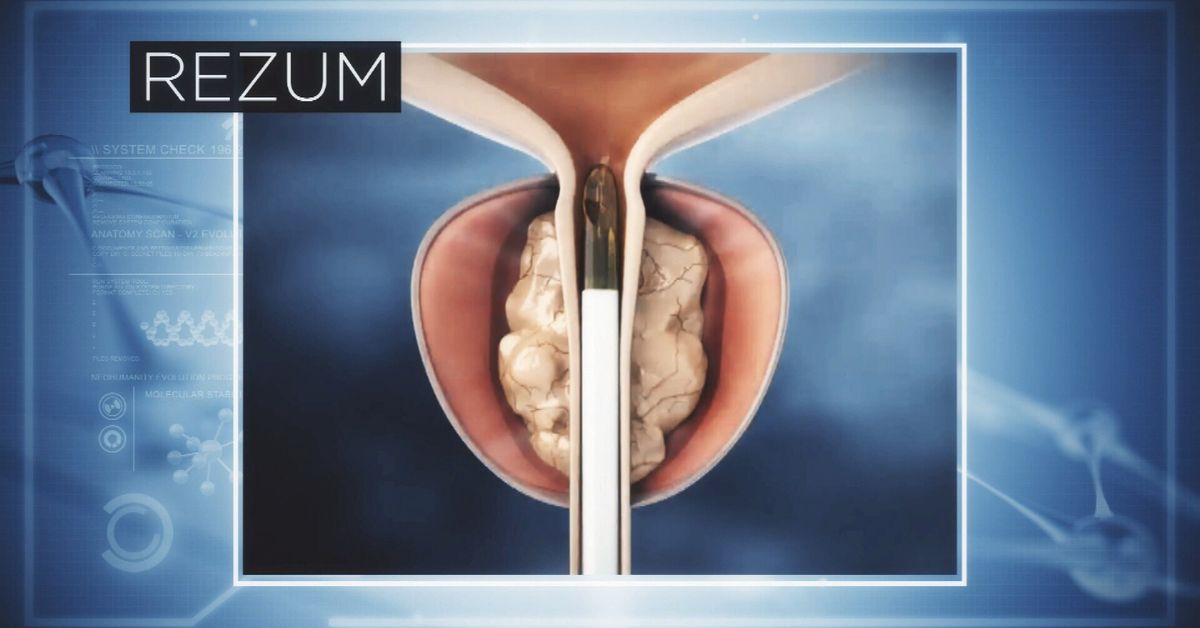
Rezūm water vapor therapy is a minimally invasive treatment that may be offered to select patients for urinary symptoms caused by benign prostatic enlargement. During the procedure, controlled water vapor is delivered to the areas of the prostate narrowing the urethra.
The thermal energy carried by the vapor causes cell death in the targeted prostate tissue. As the body gradually clears this tissue over time, the prostate shrinks and the urethra can widen. Rezūm is not a laser procedure, and no prostate tissue is cut or shaved away during the treatment.
Last medical review: 2026
Who may benefit from Rezūm?
Rezūm may be a treatment option for patients with moderate to severe urinary symptoms from benign prostatic enlargement whose symptoms have not adequately improved with medication, who cannot tolerate medication side effects, who prefer not to take long-term medication, who want a less invasive procedure, who place a high priority on preserving ejaculatory function, and whose prostate anatomy and degree of obstruction are suitable for the technique. Much of the supporting clinical evidence involves prostates of roughly 30–80 mL, though prostate volume alone is not the only consideration — the presence of a middle lobe, degree of obstruction, post-void residual urine, and bladder contractility are also assessed. A prostate over 80 mL is not an absolute exclusion, though effectiveness, catheter duration, and the likelihood of needing retreatment may differ; for markedly enlarged prostates, enucleation techniques such as HoLEP or ThuFLEP may offer more predictable results.
Who may not be suitable for Rezūm?
Rezūm may not be appropriate, or may require further evaluation first, in cases of active urinary tract infection, unevaluated suspicion of prostate cancer, significant urethral stricture, severely impaired bladder contractility, very high post-void residual urine or prolonged urinary retention, kidney function affected by prostatic obstruction, a large bladder stone or another condition requiring simultaneous surgery, or obstruction so severe that the fastest, strongest possible improvement in flow is required. Some of these are not absolute exclusions — suitability is determined after examination and testing.
How is the procedure performed?
Rezūm can be performed under local anesthesia, sedation, spinal, or general anesthesia depending on the patient. A thin instrument is passed through the urethra without any external incision, the obstructing lateral lobes and, if present, the middle lobe are visualized, and brief, controlled injections of water vapor are delivered to the targeted tissue. Some patients receive a temporary urinary catheter afterward due to expected short-term swelling of the prostate. The number of injections depends on prostate size and anatomy; the procedure itself is typically brief, though preparation, anesthesia, and post-procedure observation add to total time.
How does Rezūm work, and when does it take effect?
The water vapor spreads through the natural spaces of the prostate tissue, delivering thermal energy to the target area; treated cells lose viability, and the body gradually clears this tissue over the following weeks and months. Because of this, Rezūm's effect does not begin as quickly as with tissue-removing procedures like HoLEP or ThuFLEP, and urinary symptoms may even temporarily worsen in the first few days due to tissue swelling. Noticeable improvement is usually apparent within the first few weeks, with substantial improvement in most patients by around 6–12 weeks, and continued improvement possible over several months as the prostate continues to shrink.
Potential advantages
Potential advantages include no external surgical incision, no cutting away of prostate tissue, same-day treatment in select patients, generally short procedure time, a higher likelihood of preserving erectile and ejaculatory function compared with tissue-removing surgery, the potential to reduce reliance on prostate medication in suitable patients, and the ability to treat an obstructing middle lobe. These benefits are not guaranteed for every patient and depend on correct patient selection, prostate anatomy, bladder function, and technique.
Limitations
Limitations include a gradual rather than immediate onset of effect, possible temporary worsening of urinary symptoms in the first weeks, a temporary catheter requirement in many patients, objective flow improvement that may be less pronounced than with HoLEP, ThuFLEP, or TURP, no tissue available for pathological examination, and the possibility of needing medication or a repeat procedure in later years. Five-year clinical data suggest that benefits are maintained in many patients, but no technique eliminates the possibility of needing further treatment.
Does Rezūm affect sexual function?
One of Rezūm's notable features is a relatively high likelihood of preserving erectile and antegrade ejaculatory function; clinical studies report preservation of these functions in the majority of patients. However, no guarantee can be given for any individual patient, and reduced ejaculate volume, painful ejaculation, blood in the semen, or other changes in ejaculatory function can occur. Age, baseline sexual function, diabetes, vascular disease, and medications can all influence the outcome.
Does Rezūm treat prostate cancer?
No. Rezūm treats urinary symptoms caused by benign prostatic enlargement; it does not treat prostate cancer. Because no tissue is removed for pathological examination during the procedure, patients with suspected prostate cancer should complete PSA testing, examination, prostate MRI, or other necessary evaluation before the procedure.
Frequently asked questions
Is Rezūm suitable for every patient?
Rezūm is intended for carefully selected patients who prioritize a less invasive treatment and preservation of sexual function. Patients with very large prostates, severe obstruction, or poor bladder contractility may be better suited to other options.
Is a catheter needed after Rezūm?
Not every patient needs the same catheter duration. It depends on prostate volume, the presence of a middle lobe, pre-procedure residual urine, and voiding strength, and is typically a matter of a few days, sometimes longer.
Is Rezūm as effective as HoLEP or ThuFLEP?
Objective flow improvement with Rezūm is generally less pronounced than with tissue-removing procedures like HoLEP or ThuFLEP, but it may offer a better chance of preserving ejaculatory function. The right choice depends on prostate anatomy, symptom severity, and the patient's priorities.
This content is for general information only and does not replace individualized medical evaluation. Prepared and medically reviewed by Professor Cenk Acar, Urologist.