
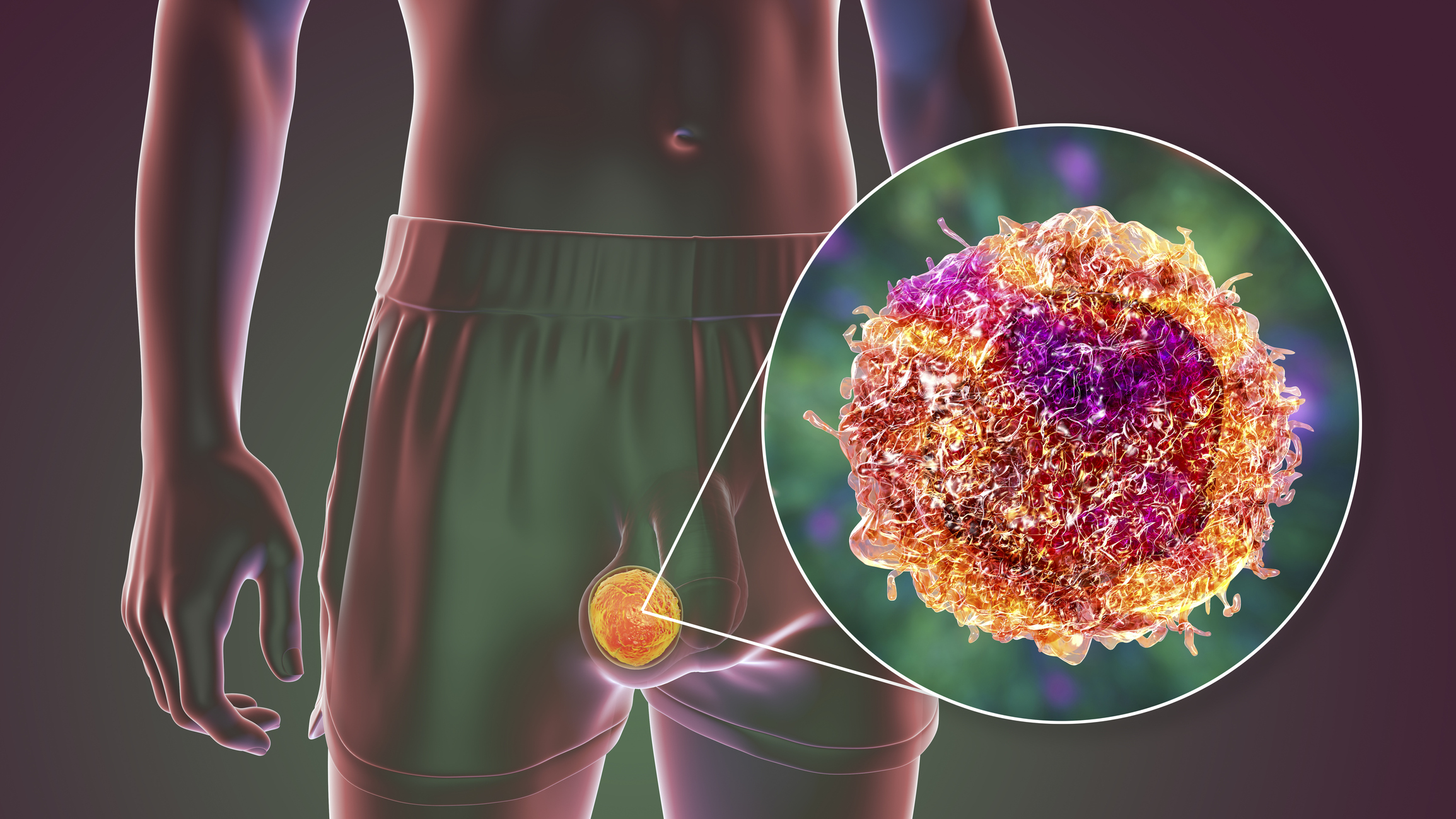
Testicular cancer develops when cells within the testicle grow in an uncontrolled way. It is uncommon compared with other cancers overall, but it is one of the most frequently diagnosed cancers in young and middle-aged men, and it is highly treatable when detected early.
Last medical review: 2026
Types of testicular cancer
Most testicular cancers fall into two broad groups. Seminomas tend to grow more slowly and generally carry a favorable prognosis. Non-seminomatous tumors — including embryonal carcinoma, yolk sac tumor, choriocarcinoma, and teratoma — tend to grow faster and are more likely to spread, which affects how they are staged and treated.
Symptoms
The most common finding is a painless lump or area of hardness in the testicle, sometimes with a sense of heaviness in the scrotum or discomfort in the lower abdomen or groin. Some men notice a change in testicular size, and rarely, breast tenderness or enlargement can occur due to hormonal effects of certain tumors. Back pain can be a sign of more advanced disease. Any new testicular lump or firmness should be evaluated promptly rather than watched.
Risk factors
A history of undescended testis (cryptorchidism) is one of the most established risk factors, even when surgically corrected in childhood. A family history of testicular cancer, a personal history of testicular cancer in the other testicle, and certain genetic conditions such as Klinefelter syndrome also increase risk. Many men diagnosed with testicular cancer have no identifiable risk factor.
How is testicular cancer diagnosed?
Evaluation begins with physical examination and scrotal ultrasound to characterize the mass. Blood tests for tumor markers — AFP, beta-hCG, and LDH — support diagnosis, help classify the tumor, and are used to monitor response to treatment. Unlike many other cancers, a needle biopsy through the scrotum is avoided because of the risk of altering the pattern of spread; when a testicular tumor is suspected, the diagnosis is generally confirmed by surgical removal of the testicle, with the tissue then examined by a pathologist. CT or MRI may be used to assess whether the cancer has spread beyond the testicle.
Treatment options
Radical inguinal orchiectomy — surgical removal of the affected testicle through a groin incision — is the standard first step for a suspicious testicular mass, both to treat the local tumor and to establish the exact diagnosis and stage. Depending on the tumor type and stage on subsequent evaluation, further treatment may include surveillance with regular imaging and tumor markers, chemotherapy, radiotherapy (mainly for seminoma with limited nodal spread), or, in select cases, retroperitoneal lymph node dissection. Because testicular cancer often affects men who have not yet completed their families, fertility preservation — including sperm banking before treatment — should be discussed before orchiectomy or systemic therapy whenever possible.
Follow-up after treatment
Even after successful treatment, regular follow-up with tumor markers, imaging, and clinical examination is important, since testicular cancer can recur, and the pattern and length of surveillance depend on the tumor type and initial stage. Long-term attention to cardiovascular health, fertility, and testosterone levels is also part of survivorship care.
Frequently asked questions
Is a painless testicular lump always cancer?
Not always, but any new lump, swelling, or firmness in the testicle should be evaluated promptly with ultrasound rather than watched, since early diagnosis significantly improves treatment outcomes.
Does removing the testicle affect fertility or hormones?
The remaining healthy testicle usually maintains adequate testosterone and fertility for most men, but sperm banking before treatment is recommended for men who may want children, since chemotherapy or radiotherapy can affect fertility.
Is testicular cancer curable?
Testicular cancer has one of the highest cure rates among solid tumors, particularly when detected early, though outcomes depend on tumor type, stage, and response to treatment, and no outcome can be guaranteed in advance.
This content is for general information only and does not replace individualized medical evaluation. Prepared and medically reviewed by Professor Cenk Acar, Urologic Oncologist.