

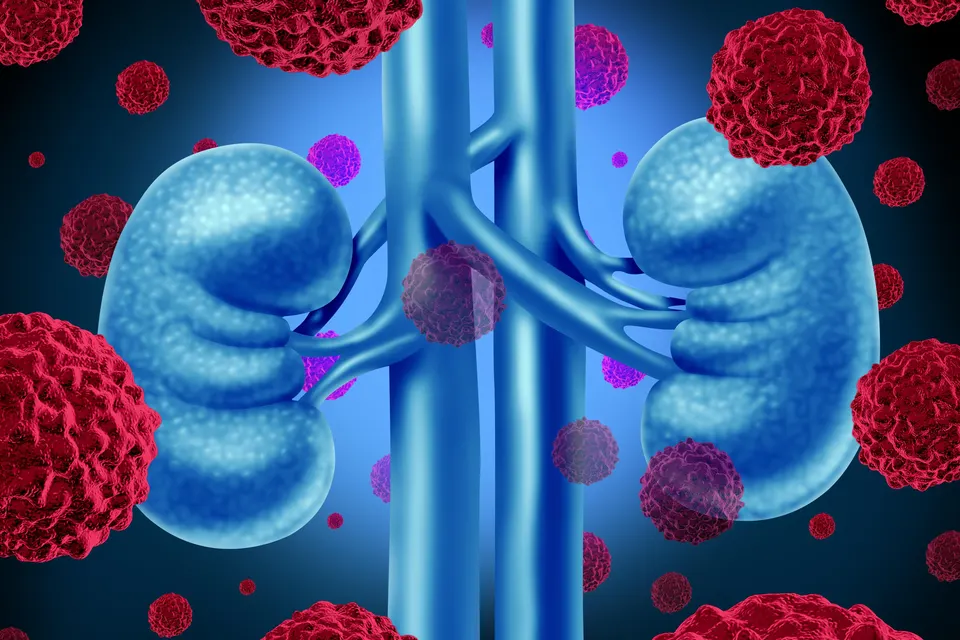
Kidney cancer is a malignant tumor that develops from kidney tissue, most commonly renal cell carcinoma. Today, many kidney tumors are found incidentally on ultrasound, CT, or MRI performed for an unrelated reason.
Not every kidney mass is cancer, and not every kidney cancer requires removal of the whole kidney. Treatment is individualized around the size and location of the mass, imaging characteristics, stage, function of the other kidney, and the patient's age and comorbidities.
Last medical review: 2026
Symptoms of kidney cancer
Early kidney cancer is usually silent. When present, symptoms can include visible or microscopic blood in the urine, persistent flank or back pain, a palpable mass, unexplained weight loss, fatigue, or new/hard-to-control high blood pressure. The classic triad of blood in the urine, flank pain, and a palpable mass is now uncommon and, when absent, does not exclude the diagnosis.
Is every kidney mass cancer?
No. A "kidney mass" is a general imaging term. Some are malignant, such as renal cell carcinoma; others are benign, such as oncocytoma or classic angiomyolipoma; and simple kidney cysts are very common and almost always benign. Complex cystic lesions are further classified using the Bosniak system (I–IV) based on contrast-enhanced CT or MRI features, which helps estimate the likelihood of malignancy and guide whether surveillance or treatment is appropriate. Size alone does not establish a diagnosis — enhancement pattern, internal structure, growth rate, location, and the patient's overall risk profile are considered together.
Risk factors
Smoking is the leading modifiable risk factor. Obesity and hypertension are also associated with increased risk, as is a first-degree relative with kidney cancer. Chronic kidney disease, particularly with long-term dialysis, and certain hereditary syndromes such as von Hippel–Lindau disease and Birt–Hogg–Dubé syndrome can also raise risk. Having a risk factor does not mean cancer will develop, and many patients with kidney cancer have no identifiable risk factor.
How is kidney cancer diagnosed?
Evaluation includes history and examination, blood and urine tests (including creatinine and estimated GFR), and contrast-enhanced multiphase CT, which is the primary method for characterizing a kidney mass. MRI may be preferred when CT is inconclusive, when venous involvement is suspected, or when iodinated contrast cannot be used. Biopsy is not required for every kidney mass — it is most useful when imaging cannot reliably distinguish benign from malignant disease, before ablation, before starting systemic therapy without surgery, or when another diagnosis such as metastasis, lymphoma, or infection is possible.
How is the stage determined?
Staging uses the TNM system, based on tumor size and extension beyond the kidney, lymph node involvement, and distant metastasis; the definitive pathological stage is usually determined after surgical removal. Routine FDG PET/CT is not recommended for initial staging — chest and abdominal imaging is typically done with CT, with brain or bone imaging added only if symptoms or clinical risk warrant it.
Treatment options
Two similarly sized kidney masses can still be treated differently. The decision considers the size, growth rate, and imaging features of the mass; its location relative to the collecting system and major vessels; whether it is solitary, multifocal, or bilateral; clinical stage; biopsy or surgical pathology subtype and grade; function of both kidneys; age and comorbidities; and the patient's priorities.
Active surveillance. For select small masses, particularly in older patients or those where treatment risk may exceed cancer risk, planned imaging surveillance may be appropriate, with a switch to treatment if the mass changes.
Partial nephrectomy. The preferred approach for most T1 tumors where technically feasible, removing the tumor while preserving as much healthy kidney tissue as possible. Robotic partial nephrectomy can offer precise tumor excision and reconstruction, which may be particularly useful for anatomically complex or endophytic masses, though not every tumor is suitable for this approach.
Radical nephrectomy. Removal of the entire kidney, considered for large, centrally located, locally advanced tumors, or those not safely removable with partial nephrectomy.
Thermal ablation. For select small T1 masses in patients with high surgical risk, image-guided freezing or heating of the tumor may be considered, usually after biopsy confirmation.
Systemic therapy. For metastatic disease, treatment is based on tumor subtype, performance status, and prior therapy, and typically centers on immunotherapy combinations and angiogenesis-targeted drugs; classic chemotherapy has limited activity in the most common clear-cell subtype.
Life with one kidney
Most people with a healthy remaining kidney can maintain normal kidney function after nephrectomy. Long-term protection of the remaining kidney benefits from blood pressure and diabetes control, avoiding unnecessary NSAIDs, maintaining a healthy weight, and periodic monitoring of creatinine, eGFR, and urine protein.
Follow-up after treatment
Follow-up is individualized based on pathological stage, subtype, grade, surgical margins, treatment received, and kidney function, and typically includes clinical evaluation, kidney function tests, and periodic imaging of the abdomen and, when indicated, the chest. Kidney cancer can recur years later, so follow-up should not be limited to the first few years alone.
Frequently asked questions
Is every kidney mass cancer?
No. Kidney masses range from simple cysts, which are almost always benign, to solid tumors that require further evaluation. Bosniak classification and multiphase CT or MRI help estimate the likelihood of malignancy.
Can the kidney be preserved during surgery?
For many T1 tumors, partial nephrectomy is the preferred option when technically feasible, removing the tumor while preserving healthy kidney tissue. Suitability depends on the tumor's size, location, and the surgeon's experience.
Is a biopsy required before treatment?
Not always. When imaging is characteristic of a surgical kidney cancer and biopsy would not change the treatment plan, surgery may proceed without it. Biopsy is more often used when the diagnosis is uncertain or before non-surgical treatments.
Source: European Association of Urology (EAU) Guidelines on Renal Cell Carcinoma, 2026. This content is for general information only and does not replace individualized medical evaluation. Prepared and medically reviewed by Professor Cenk Acar, Urologic Oncologist.