

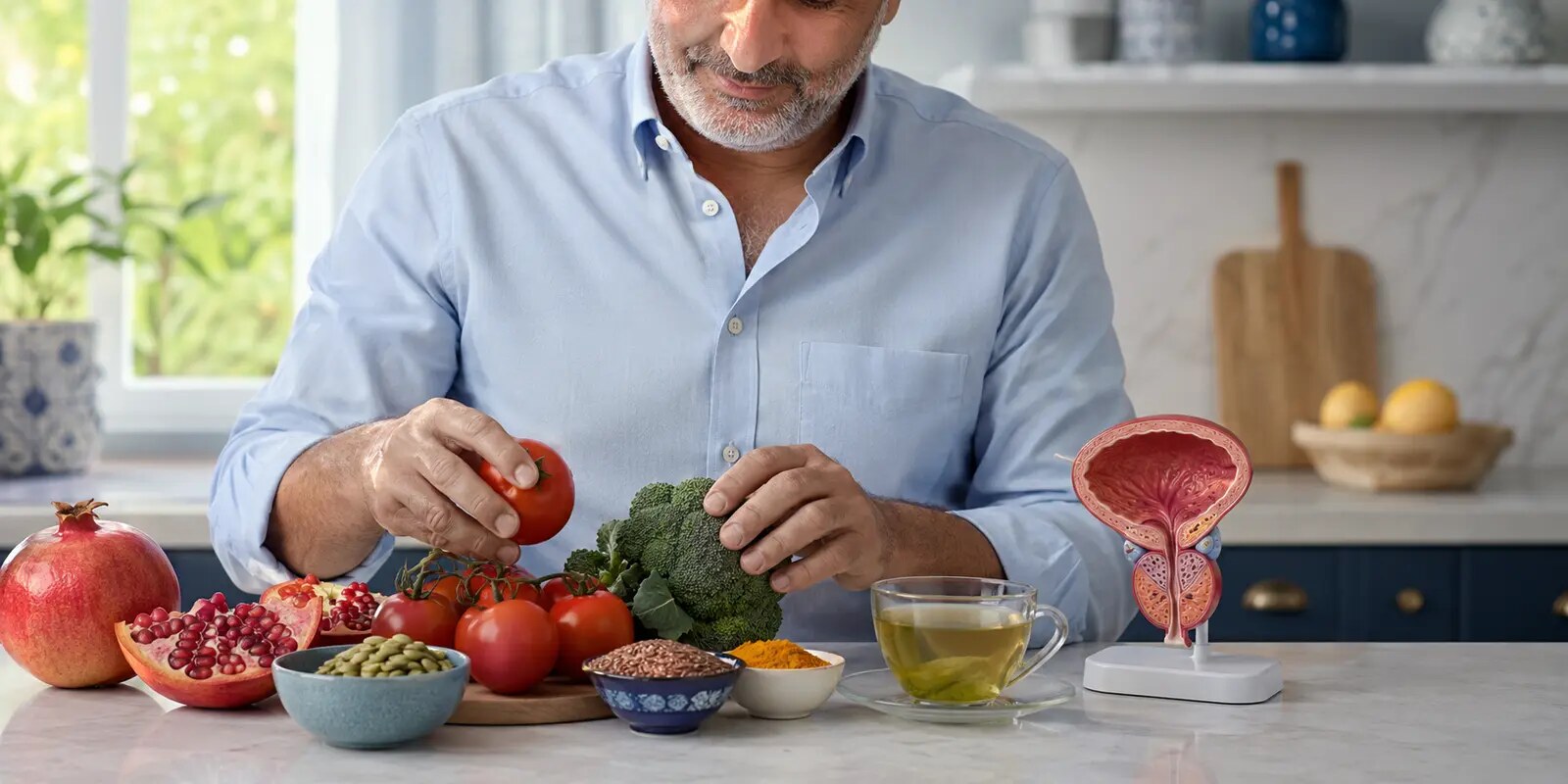
Short answer: there is no single miracle food or capsule for the prostate. However, tomatoes, pumpkin seeds, flaxseed, soy, broccoli, pomegranate, green tea, and turmeric, as part of a balanced diet, may support overall health and have been linked to favorable biological effects in some research.
If you are considering a supplement, what matters is not just the name on the label but the extract type, standardization, dose, and interaction with medications you take. No supplement replaces a prescribed prostate medication, cancer follow-up, or necessary surgical treatment.
Author and medical reviewer: Professor Cenk Acar, Urology Specialist
Last medical review: 2026
One of the questions I hear most often in clinical practice is: "Doctor, what should I eat for my prostate — which supplement should I take?" There are so many claims on store shelves, online, and in pharmacies that separating scientific evidence from good marketing is not easy.
This article is not a "miracle product list." It is a science-based roadmap from the shopping cart to the supplement label. It is important to understand from the outset that urinary symptoms related to benign prostate enlargement and the biology of prostate cancer are not the same thing — and that an effect seen in a laboratory does not mean a food prevents or treats disease in real life.
What does the science actually say about diet?
Diet may be related to prostate health through body weight, metabolic health, inflammatory processes, and oxidative stress. However, there is not enough evidence to consider any single food a definitive protective factor against prostate cancer on its own. The most realistic approach is a balanced diet rich in vegetables and fruit, with limited processed food.
Reading the evidence correctly matters: an effect seen in cell or animal studies does not prove that disease is prevented in humans. Observational studies can show an association; controlled clinical trials are needed to evaluate a treatment effect. The goal at the table is not to find "the one food that shrinks the prostate," but to build a varied, sustainable pattern that supports metabolic health.
Which foods stand out in the research?
The options that appear most often in the scientific literature are not exotic — most are available at any market. The key is treating them as part of everyday eating, not as medication.
- Tomatoes and tomato products: Lycopene, which gives tomatoes their red color, is a potent antioxidant. Laboratory studies report effects on prostate cells and pathways such as 5-alpha reductase; human studies are promising but not conclusive. Cooked tomato products may increase lycopene's bioavailability.
- Pumpkin seed: Pumpkin seed and its extracts have traditionally been used to ease lower urinary tract symptoms related to benign prostatic enlargement; the European Medicines Agency recognizes this as a traditional herbal use.
- Flaxseed: Contains fiber, lignans, and omega-3 precursors. In a controlled study before prostate surgery, men given daily flaxseed had lower Ki-67 values (a marker of tumor cell proliferation). This does not mean flaxseed alone treats cancer.
- Soy products: Soy contains isoflavones called genistein and daidzein. Some observational studies and meta-analyses report an association between soy consumption and lower prostate cancer risk, though results vary by population and product type.
- Green tea: Its leading compounds are catechins. A large observational study in Japan linked drinking five or more cups daily with lower risk of advanced prostate cancer, though not localized disease — this does not mean very high intake is advisable for everyone.
- Pomegranate: Rich in ellagitannins and other polyphenols, whose effects on oxidative stress and cell signaling are under investigation; pomegranate has not been shown to prevent or treat prostate cancer.
- Turmeric: Its active compound, curcumin, affects inflammation- and cancer-related pathways in laboratory studies. Taken alone by mouth it is poorly absorbed, and laboratory findings should not be read as direct clinical treatment results.
What did the pomegranate, green tea, turmeric, and broccoli combination show?
A standardized supplement studied under the name Pomi-T combines pomegranate, green tea, turmeric, and broccoli extracts. In a randomized, placebo-controlled trial of men on active surveillance for localized prostate cancer or undergoing PSA follow-up after treatment, the group using this product had a slower six-month PSA rise compared with placebo.
This trial is notable, but a slower PSA rise does not by itself prove a definite benefit on cancer progression, metastasis, or survival. The standardized capsule used in the study is also not equivalent, in content or dose, to eating the same foods at home.
Practical ways to add these foods to your daily diet
- Add broccoli to meals: lightly steamed or boiled broccoli a few times a week.
- Use turmeric as a spice: in appropriate dishes, in modest amounts — culinary turmeric is not the same dose as a purified curcumin supplement.
- Choose whole pomegranate over juice: the fiber in pomegranate seeds makes it a more balanced choice than juice, which carries a higher sugar load for most people.
- Adjust green tea to your own tolerance: if nighttime urination, urgency, or leakage worsens, reduce caffeinated drinks.
On the pharmacy shelf: the name of the plant is not enough
Different manufacturing methods of the same plant do not necessarily produce the same effect. A label that only states the plant's name does not guarantee the extract used, the active ingredient content, or the quality. A scientific result belongs to the specific extract and dose that was studied — it cannot automatically be generalized to every product on the shelf.
| Supplement | Use in research | Scientific assessment |
|---|---|---|
| Saw palmetto extract (Serenoa repens) | 320 mg/day of hexanic extract | EAU guidance gives a weak recommendation for standardized hexanic extract in selected men who want a herbal option; expected benefit is modest and should be discussed with the patient. |
| Pygeum africanum (African plum bark) | 100–200 mg/day of standardized extract | Short-term studies report improvement in urinary symptoms and flow; long-term data are more limited. |
| Beta-sitosterol | Variable standardized doses across studies | Short-term improvement in symptoms and flow reported; not shown to reduce prostate volume or halt disease progression. |
| Serenoa repens + lycopene + selenium combination | Product-specific standardized combinations | One randomized trial reported greater improvement in symptom score and flow when added to tamsulosin versus tamsulosin alone; not generalizable to all products. |
Doses in the table are not a personal prescription. Age, current medications, liver and kidney function, and any planned surgery can all change which supplement, if any, is appropriate.
Safety note: "natural" does not mean safe for everyone. Anyone on blood thinners, with a chronic condition, planning surgery or a biopsy, or taking regular medication should inform their doctor before starting any supplement.
Four well-intentioned mistakes
- High-dose, long-term zinc: more than 75 mg/day of zinc supplementation, or use beyond 15 years, has been linked in observational studies with higher risk of aggressive and fatal prostate cancer. This does not prove causation on its own, but it is a strong argument against unnecessary high-dose use.
- Caffeine that worsens symptoms: caffeine can increase urinary frequency, urgency, and nighttime urination in some men. If symptoms worsen after coffee or tea, reducing intake — especially in the evening — may help.
- High-dose vitamin E, mistakenly seen as protective: in the SELECT trial, healthy men taking 400 IU of vitamin E daily had a 17% higher risk of prostate cancer compared with placebo. Vitamin E supplements should not be used for prostate cancer prevention.
- Unnecessary high-dose vitamin C: there is no strong clinical evidence that high-dose vitamin C prevents prostate cancer in healthy individuals. At very high concentrations, pro-oxidant effects have been shown in laboratory settings, so "more is better" does not apply here.
Where should you start tomorrow morning?
If this article had to be reduced to one sentence: fix your plate first, then track your symptoms, and if a supplement seems needed, review the label and your personal risks with your doctor.
- Improve your overall diet first: emphasize vegetables, fruit, legumes, whole grains, and healthy fats rather than focusing on a single food or capsule.
- Track your urinary symptoms: observe over a few weeks how caffeine, alcohol, and evening fluid intake affect you.
- Check the full content of any supplement: extract type, standardization, daily dose, and other ingredients matter as much as the plant's name.
- Do not delay PSA testing and examination: diet and supplements do not explain away an elevated PSA or worsening urinary symptoms — timely urological evaluation is still necessary.
In summary: a prostate-friendly diet is built on varied, balanced food choices. Supplements can only play a supporting role with the right product, right dose, right patient, and physician input — they do not replace modern medical and surgical treatment. Improving your diet is valuable, but trying to mask urinary symptoms or an elevated PSA with a capsule is not the right approach. Nutritional support and timely urological evaluation are not alternatives to each other — done correctly, they complement one another.
Frequently asked questions
Does diet shrink the prostate?
No single food has been shown to reduce prostate size. A balanced diet may support overall urinary and metabolic health, but medication or procedures are needed to meaningfully reduce prostate volume when required.
Does tomato or lycopene prevent prostate cancer?
Laboratory and observational data are promising but not conclusive. Tomato-rich foods can be part of a healthy diet, but they should not be relied upon as prevention on their own.
Should everyone using saw palmetto take 320 mg per day?
That dose applies specifically to standardized hexanic extract studied in trials. Not every saw palmetto product on the market uses the same extraction method, so the dose and product should be individualized with medical guidance.
Can I take an herbal supplement together with tamsulosin or another prostate medication?
This should not be decided independently. Combinations have been studied for some specific products, but interactions and appropriateness depend on your individual situation and should be reviewed with your doctor.
Is eating pomegranate, broccoli, green tea, and turmeric at home the same as taking Pomi-T?
No. The trial used a standardized capsule with specific extract content and dose, which is not equivalent to the variable amounts consumed through regular food.
Should I drink a lot of green tea for my prostate?
Not necessarily. Some observational data link higher intake with lower risk of advanced disease, but high caffeine intake can worsen urinary symptoms in some men. Moderation based on personal tolerance is reasonable.
Since zinc is good for the prostate, can it be used continuously?
No. High-dose, long-term zinc supplementation has been associated with higher risk of aggressive prostate cancer in observational studies and should be avoided without a specific medical reason.
Can I monitor a rising PSA with diet or supplements instead of follow-up?
No. Diet and supplements do not replace PSA monitoring or medical evaluation. An elevated or rising PSA should always be assessed by a urologist.
Sources
World Cancer Research Fund International, Diet, Nutrition, Physical Activity and Prostate Cancer (Continuous Update Project).
European Medicines Agency, Community Herbal Monograph on Cucurbita pepo L., semen (2012) and EU Herbal Monograph on Serenoa repens fruit, hexane extract.
Demark-Wahnefried W, et al. Flaxseed Supplementation Reduces Prostate Cancer Proliferation Rates in Men Presurgery. Cancer Epidemiology, Biomarkers and Prevention, 2008.
Applegate CC, et al. Soy Consumption and the Risk of Prostate Cancer: Updated Systematic Review and Meta-Analysis. Nutrients, 2018.
Kurahashi N, et al. Green Tea Consumption and Prostate Cancer Risk in Japanese Men. American Journal of Epidemiology, 2008.
Thomas R, et al. Polyphenol-Rich Whole Food Supplement and PSA Progression: the Pomi-T Study. Prostate Cancer and Prostatic Diseases, 2014.
European Association of Urology Guidelines on Non-neurogenic Male Lower Urinary Tract Symptoms, 2026.
Wilt T, et al. Pygeum africanum for Benign Prostatic Hyperplasia. Cochrane Database of Systematic Reviews, 2002.
Wilt TJ, et al. Beta-Sitosterols for Benign Prostatic Hyperplasia. Cochrane Database of Systematic Reviews, 1999.
Morgia G, et al. Serenoa repens, Lycopene and Selenium versus Tamsulosin: PROCOMB Trial. The Prostate, 2014.
Zhang Y, et al. Zinc Supplement Use and Risk of Aggressive Prostate Cancer. European Journal of Epidemiology, 2022.
Klein EA, et al. Vitamin E and the Risk of Prostate Cancer: SELECT Trial. JAMA, 2011.
This content is for general educational purposes and does not replace individual medical examination, diagnosis, or treatment planning.