

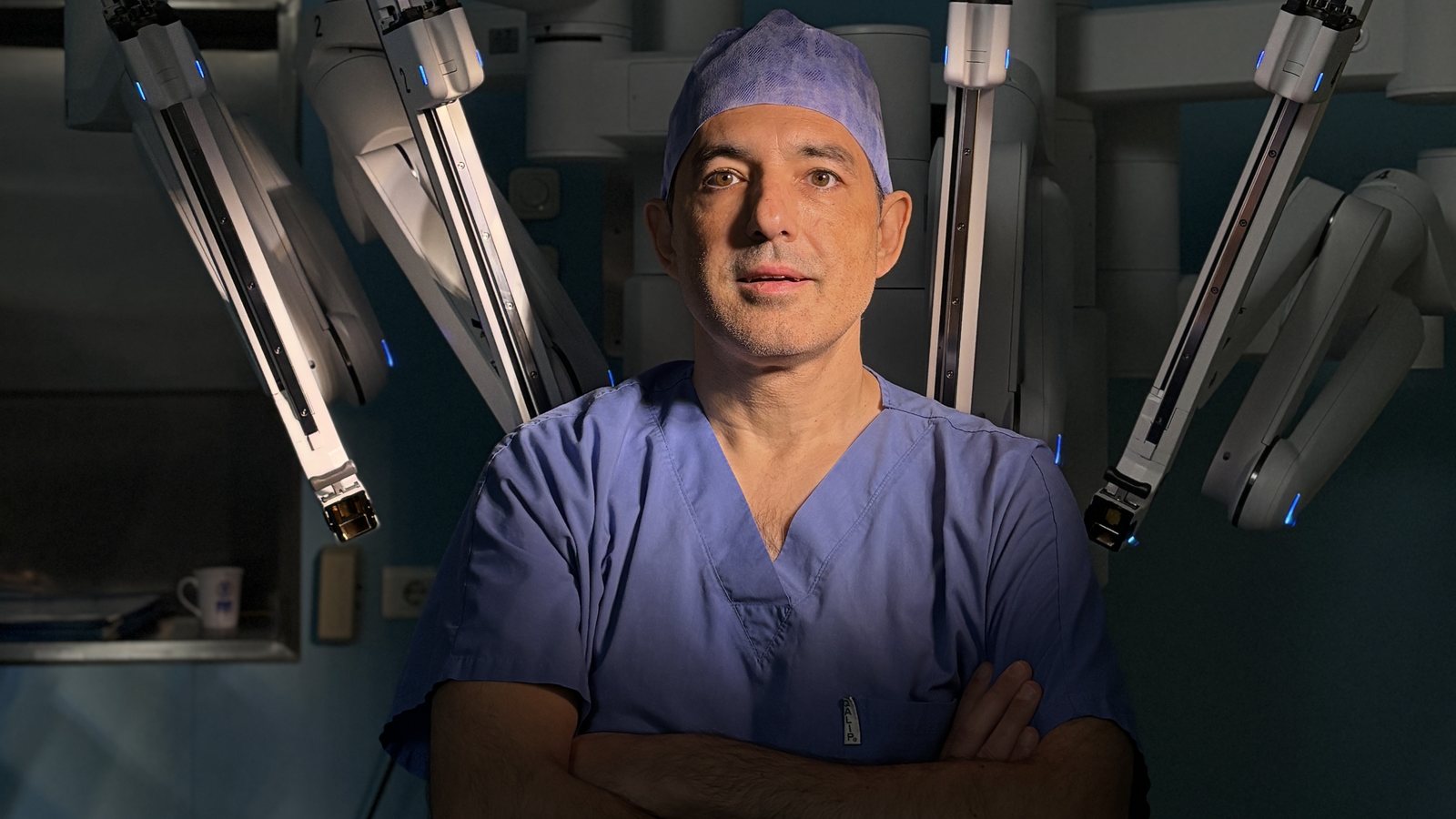
Robotic radical prostatectomy is a prostate cancer operation in which the entire prostate and the seminal vesicles are removed using a robot-assisted, minimally invasive (closed) technique. Its aim is to remove the cancer completely while preserving urinary control and sexual function as far as possible. The robot does not perform the operation by itself; the surgeon controls every movement from the console.
This operation is not the only right option for every prostate cancer. The decision is made by considering together the grade and extent of the cancer, your PSA, MRI findings, your age, your general health and your own priorities.
Prof. Dr. Cenk Acar sees patients and performs treatment at Hisar Hospital Intercontinental, Ümraniye, Istanbul.
Last medical review: 12 November 2026
Who may it be suitable for?
Radical prostatectomy is mainly discussed for cancers that are confined to the prostate or have extended just beyond it, and that are expected to be removed completely by surgery. The following information is usually evaluated together:
- Biopsy result: ISUP grade group, number of positive cores and their extent
- PSA level and prostate MRI (including samples taken with MRI fusion biopsy)
- Staging for spread in patients who need it (for example, PSMA PET/CT)
- Age, life expectancy, heart and lung condition, and previous abdominal surgery
- Urinary control and erectile function before surgery
In some low-risk cancers, close monitoring (active surveillance) may be more appropriate than surgery. For the stages of prostate cancer and all treatment options, see the Prostate Cancer guide.
Is the robotic approach better than open surgery?
The benefit of robotic surgery comes largely from its being a closed (minimally invasive) procedure: smaller incisions and usually less bleeding. In a randomized study comparing robotic and open surgery, urinary and sexual function outcomes were similar at 12 weeks and at 24 months.[3,4] For this reason, the surgeon's experience and the team's infrastructure matter as much as the method itself. The EAU guideline reports that a meta-analysis of five randomized trials comparing the robotic and laparoscopic approaches found no difference in urinary continence or oncologic outcomes at 12 months.[1] For other uses of the robotic system in urology, see the Robotic Surgery page.
How is the nerve-sparing decision made?
On both sides of the prostate run the neurovascular bundles that enable erections. Preserving these bundles during the operation is called nerve-sparing surgery. According to the EAU guideline, nerve sparing probably improves functional outcomes such as early urinary continence and erectile function; however, it may also increase the likelihood of a positive surgical margin.[1]
For this reason, the decision is made separately for each side. The side on which the tumor lies, any suspicion of extension beyond the capsule on MRI, the biopsy grade and erectile function before surgery are evaluated together. On the side where the cancer is close to the capsule, not preserving the nerves may be safer for cancer control. The nerve-sparing plan is based on the tumor location on prostate MRI and is discussed openly with you before surgery.
How is the operation performed?
- Under general anesthesia, a camera and instruments are inserted through several small incisions in the abdominal wall.
- The prostate and seminal vesicles are separated from the surrounding tissues; on the appropriate side, the neurovascular bundles are preserved.
- In patients who need it, the pelvic lymph nodes are also removed; this decision is based on the risk group and imaging.[1]
- The bladder neck is re-attached to the urethra with sutures (anastomosis), and a urinary catheter is placed until this connection heals.
- The removed tissue is sent for pathological examination.
Hospital stay and catheter duration
The length of the hospital stay and the time spent with a catheter vary according to the healing of the anastomosis, the extent of the operation, other medical conditions and how quickly you recover. In our clinic, the hospital stay is usually 3 days, and the urinary catheter stays in for around 7 days in total; the duration expected in your case is discussed before surgery. Whether infection prevention is needed when the catheter is removed is determined according to the EAU guideline on urological infections.[1]
Urinary control
After the catheter is removed, leakage of urine when coughing, standing or exerting yourself is common, and in most patients it decreases over a period of months. Recovery is influenced by age, body mass index, other medical conditions, urinary complaints before surgery, prostate volume and surgical technique.[2] Pelvic floor exercises are generally recommended. Permanent and significant urinary incontinence develops in a small number of patients, and treatment options exist for this as well.
Sexual function
After surgery, no semen is released at orgasm; the sensation of orgasm usually remains. The return of erections depends mainly on age, erectile function before surgery, other medical conditions and the extent to which nerve sparing could be performed.[2] Recovery may take months; if needed, medication and other rehabilitation methods are used. No method can guarantee that erections will be preserved.
Possible risks
Bleeding and the need for blood transfusion, infection, anastomotic leakage, bladder neck stricture, bowel or blood vessel injury, blood clots, collection of lymph fluid and, rarely, conversion to open surgery. The EAU guideline reports that most of these complications are reported at low rates in robot-assisted surgery; your personal risk is discussed separately before surgery.[1]
Follow-up after surgery
The pathology report shows the grade of the cancer, whether the margins are clear, and the status of the lymph nodes. After surgery, PSA is expected to fall to an undetectable level, and it is measured at set intervals. In some patients with a high PSA before surgery, an early measurement may be misleading; PSA may take months to fall.[1] For some patients follow-up is sufficient, while others may need additional treatment such as radiotherapy or hormone therapy. You can read how PSA values are generally interpreted in the article on elevated PSA (in Turkish).
Alternatives
- Active surveillance: In low-risk and selected intermediate-risk cancers, monitoring with regular PSA, MRI and, when needed, biopsy.
- Radiotherapy: In suitable patients, a curative alternative to surgery; depending on the risk group, it may be given together with hormone therapy.
- Open or laparoscopic prostatectomy: Different approaches to the same operation.
Which option is more suitable for you is decided by discussing the benefits and side effects together. Where possible, the opinions of both urology and radiation oncology should be obtained.
Frequently asked questions
Can the cancer come back after robotic surgery?
If the margins and lymph nodes are clear on pathology, the risk of recurrence is low but not zero; this is why PSA follow-up is carried out.
Can nerve sparing be performed in every patient?
No. On the side where the cancer is close to the capsule, the nerves may not be preserved, for the sake of cancer control.
Where is the surgeon during robotic surgery?
In the same operating room, at the console. The assistant surgeon and the team are at the patient's side.
How is PSA monitored after surgery?
The frequency of follow-up is determined according to the PSA value measured in the 6th week after surgery. After that, PSA is checked every 3 months for 2 years. If PSA rises, follow-up is re-planned individually.
This content is for general information only and does not replace a personal examination, diagnosis and treatment plan.
References
- European Association of Urology. Guidelines on Prostate Cancer – Treatment, 2026 (section 6.2.2: radical prostatectomy, nerve sparing, complications, PSA persistence).
- Ficarra V et al. Systematic reviews of urinary continence (Eur Urol 2012;62:405–17, doi:10.1016/j.eururo.2012.05.045) and erectile function (Eur Urol 2012;62:418–30, doi:10.1016/j.eururo.2012.05.046) after robot-assisted radical prostatectomy.
- Yaxley JW et al. Robotic vs open prostatectomy, early outcomes. Lancet 2016;388:1057–1066. doi:10.1016/S0140-6736(16)30592-X
- Coughlin GD et al. Robotic vs open prostatectomy, 24 months. Lancet Oncol 2018;19:1051–1060. doi:10.1016/S1470-2045(18)30357-7